
海边的曼彻斯特
盈富基金获南向资金净买入38.62亿港元_我的网站

一 |
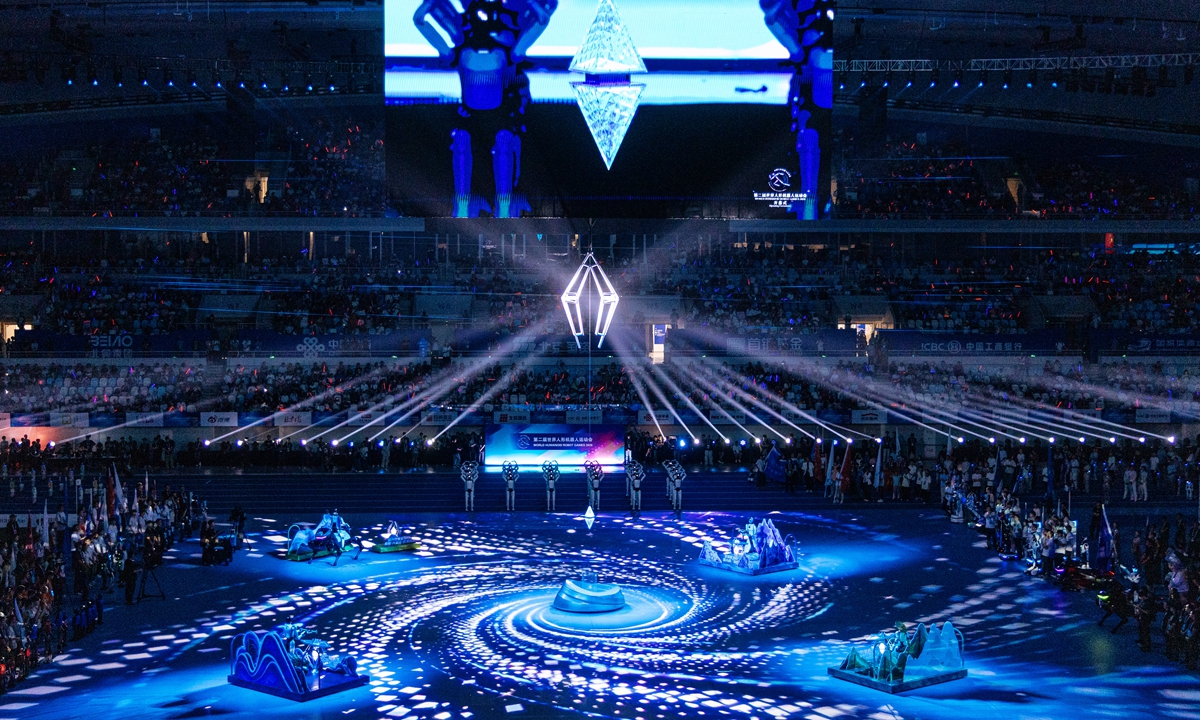
The lights went down inside the National Speed Skating Oval. A humanoid robot riding on a robotic horse, lifted a bow, drew back the string and let the arrow fly.
The arrow found its mark, and the “Zhixin,” or intelligence chip — this competition’s equivalent to the Olympic flame — lit up above the arena. The venue erupted in cheers.
With that, the 2nd World Humanoid Robot Games opened on Saturday at the Beijing venue better known as the “Ice Ribbon” — the capital’s second robotics showcase in a week, following the 2026 World Robot Conference, which opened on August 19.
The opening ceremony began with demonstrations of the 100-meter sprint and the standing high jump. In the sprint, a humanoid robot clocked 9.39 seconds — faster than the men's 100-meter world record of 9.58 seconds set by Jamaican sprint legend Usain Bolt. In the high jump, a humanoid robot reached 288.43 centimeters. Both marks were set by the Tien Kung Ultra humanoid robot by Beijing-based X-Humanoid. Table tennis, tennis, football and other events were then demonstrated jointly by elite human athletes and robots.
The parade of international delegations and robot contingents followed, including formations of humanoid robots from Booster Robotics, Galbot and Noetix Robotics. The robots performed drills as they marched, all of it done autonomously with no remote control.
The X-Humanoid fielded a 50-strong contingent of its Tien Kung 3.0 robots. Tien Kung 3.0 also served as the only robot flag bearer of the games, marching at the head of all contingents while waving the games flag, and it is also the humanoid robot archer who lighted the “Zhixin”, the company told the Global Times.
More than a thousand robots appeared over the course of the ceremony, in a series of joint performances with humans — an opening overture played by humanoid robot musicians alongside a human orchestra, and segments with pop singers, with the judges of the dance events taking the floor themselves, and with children.
Taishan Sports, the Shandong-based official equipment supplier of the games, provided the running tracks, the artificial turf for the football pitches, the floor surfacing for events including the long jump, high jump and weightlifting, and the impact mats that slow the robots down at the end of the sprint lanes.
"Robots are very heavy, and what they need from a surface in terms of hardness and friction is not what a human runner needs, so we adjusted the material formula specifically," Man Fangfang, the vice director of the company, told the Global Times at the venue. The artificial turf was reworked the same way — robots do not play football the way people do, and the turf has to be non-slip and antistatic.
The company spent months talking to the competing teams and retesting the gear before the games. Taishan Sports has supplied equipment to eight Olympic Games and more than 3,000 sporting events, "but this is our first time serving robot games," she said.
China's robotics industry is growing fast and robots are moving into every sector, while the sports industry has always lent itself to crossover with other fields, Man said, adding that the company wants to use the games to work out what equipment suits robots and to develop more of it.
Compared with the first edition, the second games have expanded in both scale and quality. A total of 666 teams and 2,056 robots from 16 countries across six continents are competing, with the number of teams up 138 percent from the first edition and the number of robots quadrupling, according to CCTV.
Competition events have doubled from 26 to 51, while the number of matches has more than doubled from 487 to 1,301. More combative and spectator-friendly events such as martial arts and dance have been added to the competitive program.
Notably, the second games set stricter autonomy requirements for the robots. Except for the 100-meter and 400-meter obstacle races, all track events and other competitive events must be completed by robots fully autonomously. In scenario-based events, a task completed fully autonomously carries a final score weighting coefficient of 1, while one completed by remote control carries only 0.5, per CCTV.
Analysts said the higher bar on autonomy is in line with the industry’s development goal of having robots complete tasks without human operation.
。

二 | 南向资金净买入115.67亿港元,盈富基金、阿里巴巴-W、腾讯控股净买入额位列前三,分别获净买入38.62亿港元、21.84亿港元、15.43亿港元。净卖出方面,中芯国际、华虹宏力、泡泡玛特分别遭净卖出18.95亿港元、8.72亿港元、4.26亿港元。(第一财经)原文链接。
Current article:http://95p3.qiniaohongfangfoguisenzhai.cyou/list_jpb/4fw.html
Published on:01:17:49
我的网站最新文章
- 收官之作!检验类立项指南正式发布
- 2冠2亚收官!中国公开赛国羽成绩不如上届,男单、男双已成短板?
- “塘街夜市”解锁双倍烟火气
- AI招人,比人类更容易产生偏见
- 机器人搏击名场面!“旋风踢”踢出个“躺赢”
- 美团平台乱派单超时追责骑手不让截屏存证太霸王
- 惊天手笔!市值85亿公司狂砸百亿买设备,赌上全部身家押注AI算力
- 杭州调整防台风应急响应至Ⅲ级
- 战报!抚顺队夺冠
- 晋中市:让夜晚“亮”起来、人气“聚”起来、消费“活”起来
- 前7月全国铁路累计完成旅客发送量28.01亿人
- More than 1,600 migrants arrive on Spanish Canary Islands
- 新赛季CBA10月10日开赛 推动第二阶段恢复主客场
我的网站随机推荐
- 卡斯尔:文班休赛期难以捉摸 社媒常晒奇特地点
- 河村勇辉秀完美肌肉线条!辻直人:身体素质太强了,1.72米能撞飞吕俊锡
- 行情波动,是“去火“还是“反转“?
- 暑期休闲,这些玩法人气高(探访·暑期消费)
- Shams:巴斯家族决定售空股份 珍妮无法任管理
- 特斯拉第三季度营收214.54亿美元 净利润同比增长103%
- Olympic champion Wu Dajing appointed China short track head coach
- 记者:文森特有意回归热火 球队还剩1个标准名额
- Tech exchange drives China-Cambodia industrial cooperation at Phnom Penh machinery show
- 智谱创新研究院落户上城,携手浙大启动六大项目
- 河北张家口市场监管局回应“博主曝光大白菜装车前蘸甲醛保鲜”:关注到相关情况 多部门已展开调查
- 爱彼迎要下场搞旅游社交了?
- 中超联赛第十轮:首阶段收官战 津门虎要重塑信心